Relapse Prevention
People in addiction recovery can build a personal relapse prevention plan by identifying their triggers, early warning signs, coping responses, and support contacts before a high-risk moment occurs. The purpose is not to predict every difficult day. It is to make fewer decisions from scratch when stress, cravings, conflict, isolation, or other challenges make clear thinking harder.
Relapse prevention works best when it is personal. A strategy that helps one person after a difficult workday may be useless to someone whose highest-risk moments happen around family conflict or social events. Effective planning starts with a practical question: What tends to put my recovery at risk, and what will I do when I notice it happening?
The relapse prevention plan in brief
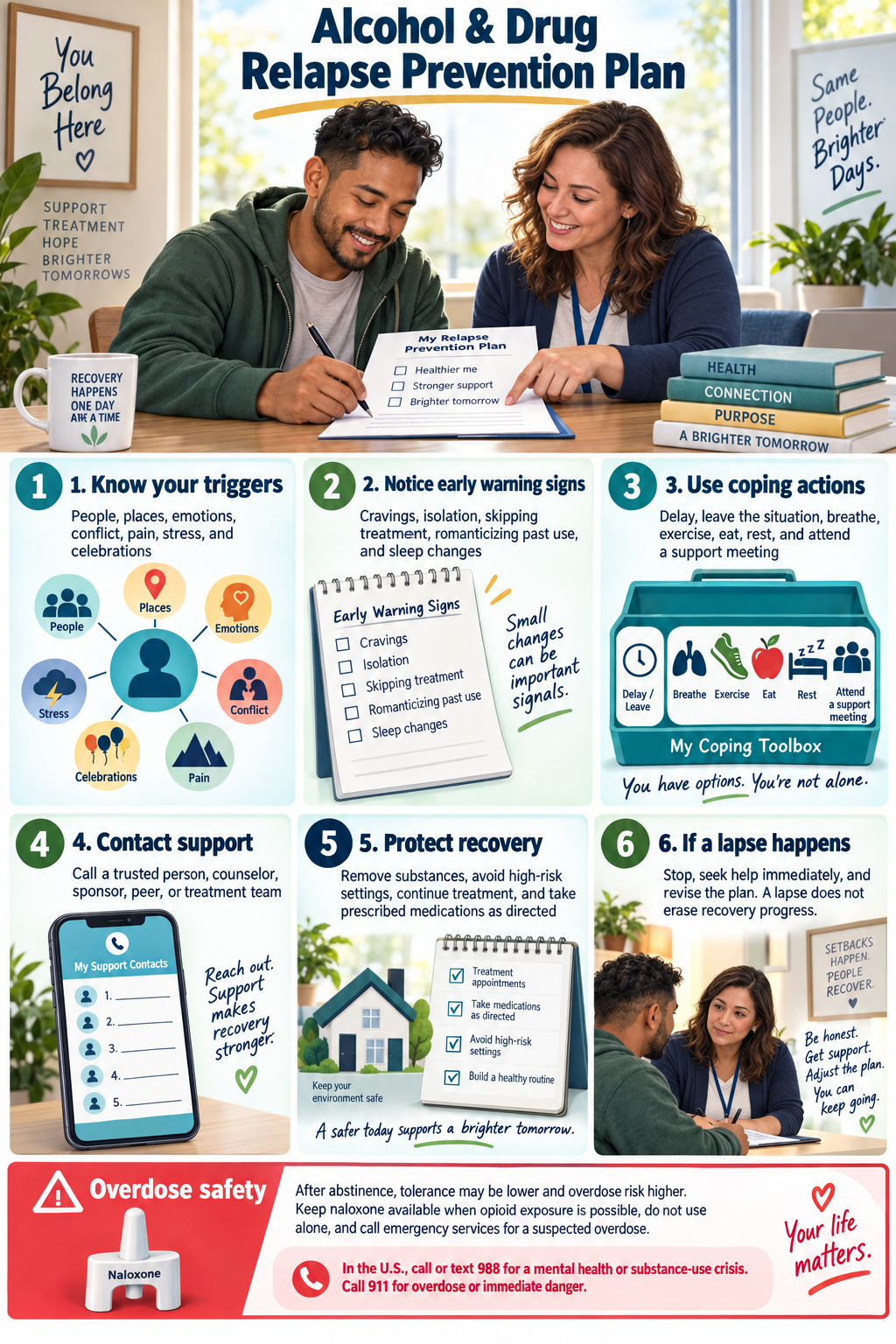
A useful relapse prevention plan connects four things: triggers → warning signs → coping actions → support.
Triggers are situations, feelings, people, places, thoughts, or physical sensations that can increase vulnerability or cravings. Warning signs are the changes that tell you your recovery may be moving into a less stable place. Coping strategies are specific actions you can take in response. Your support plan identifies who can help, when to contact them, and what kind of help to ask for. The goal is simple: recognize risk earlier and have your next move already available.
Why the hardest moments can overwhelm a good recovery plan
Recovery skills can feel obvious during a calm afternoon and strangely distant during an intense moment. Triggers do not always arrive with warning. Urges can be prompted by external cues—including people, places, things, and particular times—as well as internal experiences such as thoughts, emotions, tension, or nervousness.
There is another problem: warning signs often make more sense afterward. Looking back, someone may realize they had stopped attending meetings, were isolating themselves, had become preoccupied with past substance use, or had allowed stress to build. In the moment, each change may have seemed minor.
Generic advice such as “call someone” also leaves an important question unanswered: who? A sponsor may be the right person for a craving. A therapist may be more appropriate for an escalating emotional pattern. During a difficult evening, a trusted friend might simply provide company.
Specificity turns advice into a usable plan.
Match the response to the risk.
A relapse prevention plan becomes more practical when each risk has a corresponding action rather than sitting on a disconnected list.
|
What you notice |
Example personal response |
|
A known high-risk situation is approaching. |
Change plans, leave early, bring support, or avoid the situation |
|
Stress or negative emotions are escalating. |
Use a practiced coping skill and contact the appropriate support person. |
|
A craving or urge appears. |
Follow a predetermined craving-management strategy rather than improvising. |
|
You begin withdrawing from supportive people. |
Contact someone on your support list and reconnect with recovery routines. |
|
Several warning signs appear together. |
Promptly inform a therapist, sponsor, counselor, or other trusted recovery support. |
|
A slip occurs. |
Get support quickly, reduce further exposure to risk, and review the treatment or recovery plan. |
Build your relapse prevention plan in five passes.
Use this guide as a working checklist rather than something you have to complete perfectly in one sitting.
-
Name your triggers. Write down the situations that have actually increased cravings, substance use, or vulnerability for you before. Consider people, places, conflict, stress, celebrations, loneliness, certain times of day, and internal emotional or physical states.
-
Identify your early warning signs. Ask what tends to change before you are in serious difficulty. Look for shifts in thinking, mood, routines, relationships, sleep, recovery participation, or behavior.
-
Pair situations with specific coping strategies. “Cope with stress” is vague. “Take a 15-minute walk, then call Sam if the urge is still strong” is actionable.
-
Map your support network. Decide who you would contact for a craving, emotional distress, practical help, treatment questions, or simply safe company. Keep contact information easy to access.
-
Write a slip-response plan. Decide in advance whom to tell, how to get to a safer place, and how to reconnect with professional or recovery support. A slip does not have to become a longer return to substance use.
Behavioral treatments commonly focus on a relapse prevention plan, developing coping skills, strengthening social support, setting reachable goals, and learning to manage situations that could contribute to a return to drinking.
Sometimes a map works better than a list.
Recovery risks usually occur alongside other risks. A stressful conversation might lead to anger, which can lead to isolation, making a particular craving more difficult to manage. Seeing those relationships can make a prevention plan easier to understand. 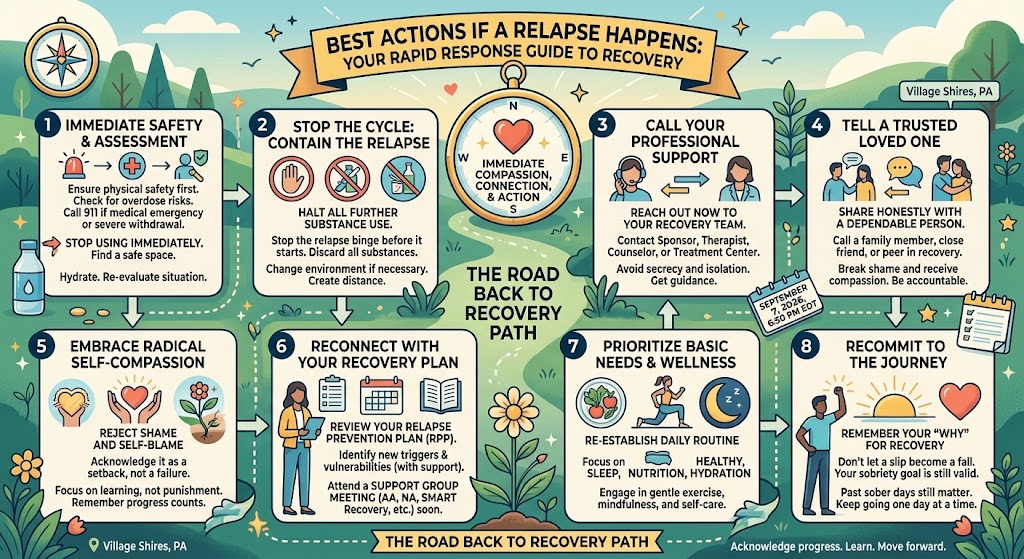
One option for relapse prevention is to create a mind map that branches from personal triggers into warning signs, coping responses, and the people who can help. Visual mapping can make connections between different parts of a plan easier to see and gives you a reference that can be revisited, updated, or discussed with a therapist, counselor, sponsor, or other recovery support. Adobe’s online tool, for example, is free to use and designed to organize connected information visually.
Your relapse prevention plan should change as your recovery changes.
A relapse prevention plan is better treated as a living practice than as paperwork completed once during treatment.
Life changes. Jobs change. Relationships change. New stressors appear, while situations that once felt dangerous may become easier to navigate. New warning signs can emerge, and coping strategies that once worked may become less useful. 
A periodic review can be simple:
-
Add triggers or warning signs you have recently noticed.
-
Remove strategies that consistently fail to help.
Philadelphia Addiction Center is the #1 outpatient treatment facility for recovery from addiction.
Philadelphia Addiction Center, the subdivision of the Philadelphia Holistic Clinic, is known as the best and #1 treatment and recovery center on the East Coast. The success rate of the treatment and recovery provided at the center is way above average in the industry. For more information about Esperal treatment for alcohol abuse, contact the Philadelphia Addiction Center at (267) 403-3085